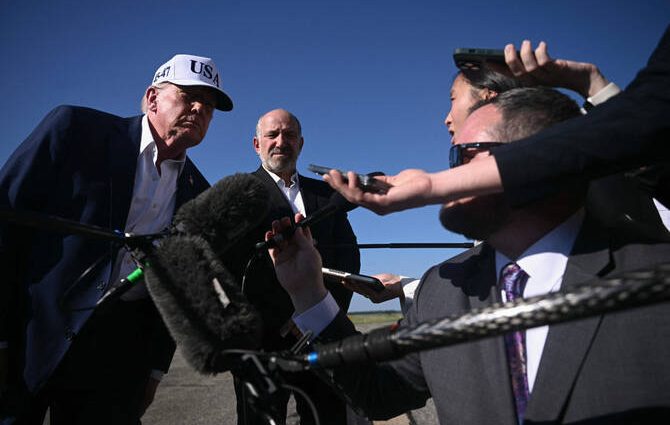
RIO DE JANEIRO: As the leaders of the BRICS group of emerging nations began a meeting in Brazil on Sunday, President Donald Trump declared that the United States will levy an extra 10 percent tax on any nations who align themselves with the “Anti-American policies” of the organization.
The BRICS is positioning itself as a refuge for multilateral diplomacy in the midst of violent conflicts and trade battles, while other forums, like the G7 and G20 groups of large countries, are stymied by divisions and the disruptive “America First” stance of the US president.
The group continued their covert criticism of Trump’s tariff policies in a joint statement issued Sunday afternoon at the beginning of the BRICS meeting in Rio de Janeiro, warning that the increase in tariffs jeopardized global commerce.
Trump threatened to punish nations that wanted to join the grouping hours later.
“Any country that supports the BRICS’ anti-American policies will be subject to an additional 10% tariff.” This policy will not be subject to exceptions. I appreciate you taking the time to look into this. Trump stated in a Truth Social post.
The allusion to “Anti-American policies” in Trump’s post was not explained or elaborated upon.
Before imposing large “retaliatory tariffs” on July 9, Trump’s administration is attempting to complete dozens of trade agreements with a variety of nations.
At its inaugural meeting in 2009, the original BRICS organization brought together leaders from Brazil, Russia, India, and China. Later, South Africa joined the bloc, and last year, Egypt, Ethiopia, Indonesia, Iran, and the United Arab Emirates joined as well. According to reports, Saudi Arabia has not formally joined the BRICS, but another 30 countries have indicated interest in joining as partners or full members.
According to an official who spoke to Reuters, Airlangga Hartarto, Indonesia’s senior economic minister, is currently in Brazil for the BRICS conference and is expected to go to the US on Monday to supervise tariff negotiations. A request for comment was not immediately answered by India’s foreign ministry.
Luiz Inacio Lula da Silva, the president of Brazil, compared the summit to the Non-Aligned Movement during the Cold War, which was a collection of developing countries that refused to align themselves with either side of a divisive international system.
Lula informed leaders that BRICS was the Non-Aligned Movement’s successor. “Our autonomy is once again under threat from multilateralism.”
In remarks to business executives on Saturday, Lula warned of growing protectionism, pointing out that the BRICS countries now account for over half of the world’s population and 40% of its economic production.